
Scripture of the Day: Exodus 14
14:14 “Yahweh will fight for you, and you shall be still.”
WEB
It is easy to understand their fear. They cried out and questioned Moses. Sometimes when trouble appears, we quickly forget how God has already provided for us.
But Moses’ response is striking. “Don’t be afraid. Stand still.” Those words seem almost impossible in a crisis. Everything inside us wants to run, fix, or panic. Yet Moses pointed them toward trust.
God told Moses to lift his staff and stretch out his hand over the sea. Then something extraordinary happened. The waters parted. The people walked through on dry ground, with walls of water on either side.
This miracle was not just about escape. It was about revelation. God showed His people that He fights for them. He makes a way where there seems to be none.
In our lives, we may not stand before a literal sea. But we face moments that feel just as overwhelming—decisions, fears, conflicts, uncertainties. We may feel trapped between what was and what lies ahead.
Exodus 14 teaches us that God often works when we feel most helpless. “Yahweh will fight for you.” That promise still echoes today.
Standing still does not mean doing nothing. It means placing our trust in the One who holds the waters in His hands. It means believing that the obstacle before us is not greater than the God beside us.
The image of Moses pointing forward with his staff reminds us of faith in action. He trusted God’s command even before he saw the path open.
When the sea stands in front of you, remember: the same God who parted the waters is still powerful today.
Why is it hard to “stand still” when we are afraid?
Can you think of a time when God made a way for you unexpectedly?
What “sea” feels overwhelming in your life right now?
How can you practice trusting God in that situation?
Today's Free Printable
Exodus 14 – Parting of the Red Sea Devotional Drawing Page
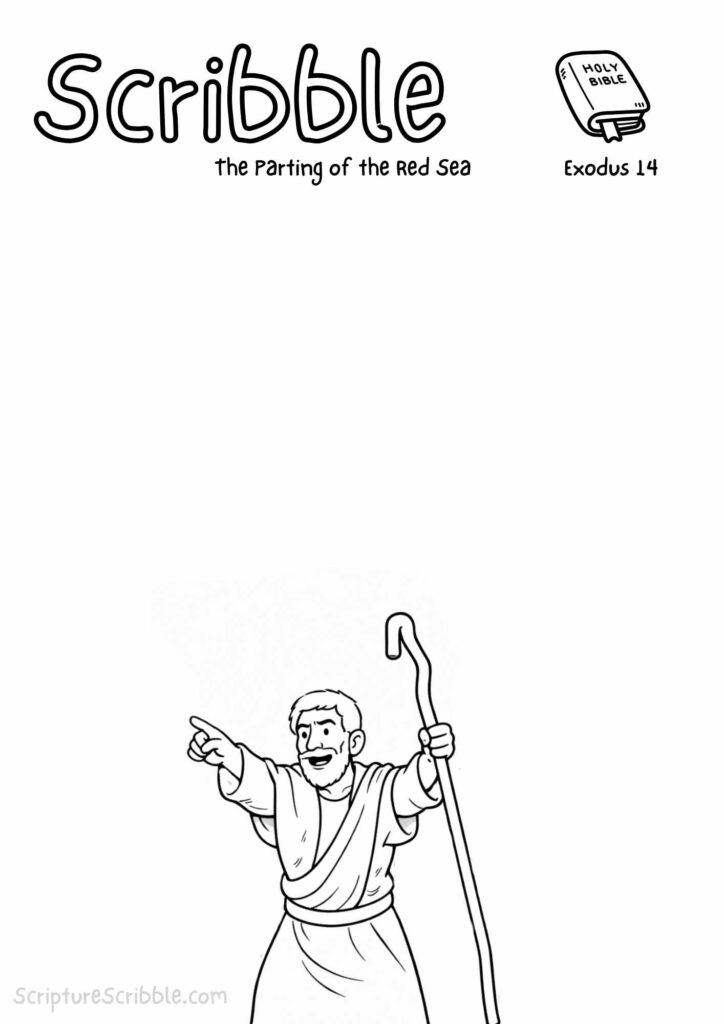
How to use this printable
How to Use This Printable as Part of a Devotional
This page is designed to fit naturally into personal, family, or group devotional time.
Rather than simply reading the passage, this approach invites you to slow down and engage
with Scripture visually and reflectively.
1. Begin With Stillness
Before reading, take a quiet moment. You may wish to sit in silence for 30–60 seconds,
pray briefly for understanding, or ask God to help you notice something meaningful.
Devotional drawing works best when unhurried.
2. Read the Scripture Slowly
Read the passage listed at the top of the page. If possible, read it once silently, then
read it again aloud. Pause between readings.
- Notice words or phrases that stand out
- Pay attention to emotions in the scene
- Watch for actions, reactions, or surprises
3. Observe the Starter Image
Look carefully at the simple illustration on the page. It captures only part of the moment.
Consider what might be happening just outside the frame and what details the passage includes
that are not shown.
4. Draw as Reflection
Begin drawing the rest of the scene. As you draw, let it become part of your meditation on the
Scripture. There is no correct interpretation—the act of drawing helps you linger with the text.
- Draw the environment or setting
- Add other people in the story
- Show movement or stillness
- Use light, distance, or atmosphere to express meaning
5. Pause and Reflect
When you finish drawing, take another moment to reflect. You may find it helpful to ask:
- What did I notice that I might have missed otherwise?
- How does this scene reveal God’s character?
- What does this moment teach about trust, obedience, fear, or faith?
- How might this apply to my life today?
You can journal, pray, discuss, or sit quietly.
6. Close With Prayer
End your devotional by responding in prayer. You might thank God for what you noticed, ask for
strength related to the passage, or reflect on how the scene connects to your current season.
Using This in Different Devotional Settings
Personal Quiet Time
Use one page alongside your daily Scripture reading and return to it later in the day.
Family Devotions
Read together, draw separately, then share what each person noticed (no correcting—everyone sees it differently).
Small Groups or Church
Allow quiet drawing time, then invite voluntary sharing and discussion.
A Gentle Reminder
This is not about artistic skill. It is about slowing down, paying attention, and creating space
for Scripture to settle more deeply. Even simple drawings can lead to meaningful insight.
Color This Printable Online
Launch the interactive coloring studio to draw, erase, undo, and export your artwork as PNG.